Carried by ocean currents for months, the young larvae eventually transform into transparent juvenile eels known as glass eels, or elvers. These tiny creatures arrive along the coast of Nova Scotia and begin swimming inland into rivers, estuaries, and lakes, where they may live for decades before repeating the cycle themselves.
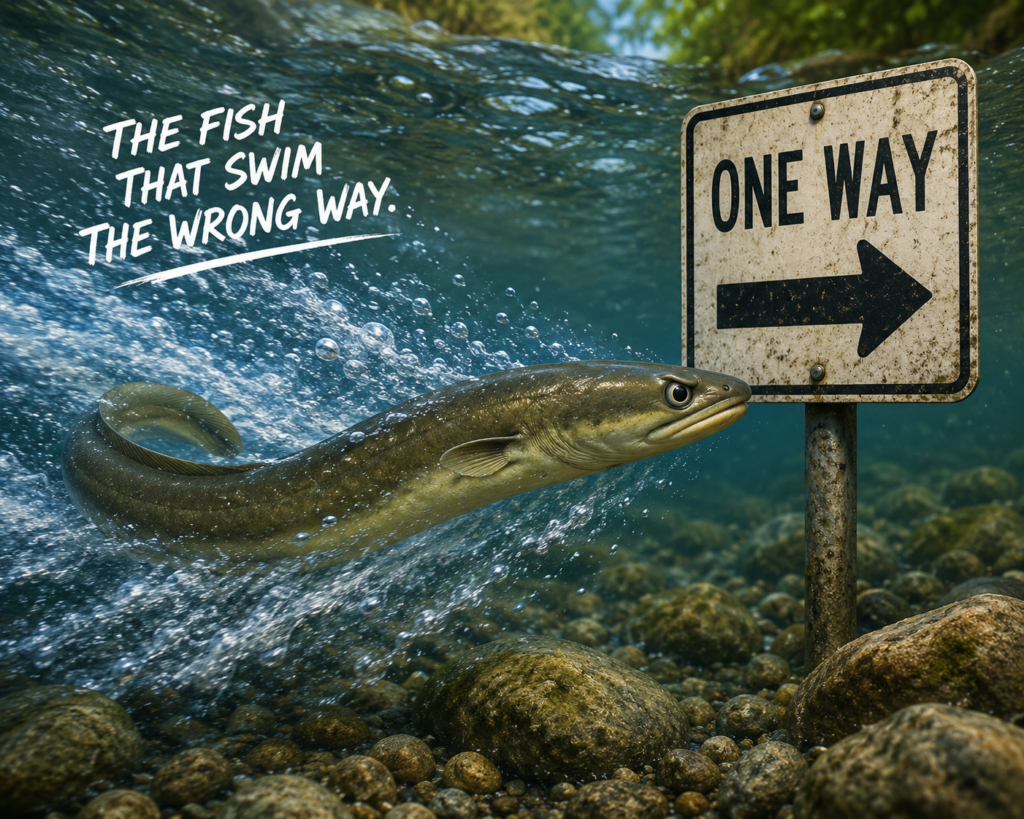
Many people assume eels follow the same lifecycle as salmon — born in rivers, maturing in the ocean, then returning upstream to spawn. In reality, eels do almost the opposite. Salmon are born in freshwater and mature in the sea. Eels are born in the sea and mature in freshwater.
In many ways, they are the fish that swim the wrong way.
After learning this, I asked several other people about eel migration. Most did not know eels originated in the open Atlantic, and many assumed they spawned locally in Nova Scotia rivers. It is one of those hidden natural stories happening all around us, largely unnoticed.
For centuries, the mystery puzzled scientists as well. No one could find eel eggs or spawning grounds, leading to strange theories that eels emerged from mud or simply appeared in wetlands. It was not until the twentieth century that researchers confirmed the importance of the Sargasso Sea to the lifecycle of the American eel.
Today, elvers have become internationally valuable, particularly for aquaculture markets in Asia, where young eels are raised to adulthood for food. A single kilogram can be worth thousands of dollars, making the fishery one of the most valuable by weight in Canada. That value has also brought controversy, illegal harvesting, and conflict in Atlantic Canada as governments, Indigenous communities, and commercial fishers struggle to balance conservation, enforcement, and access.
Yet beyond the headlines and economics, elvers are deeply connected to the identity of Nova Scotia’s Eastern Shore. Every spring, rivers flowing into the Atlantic quietly welcome another generation returning from the sea. The eels themselves play an important ecological role, carrying nutrients between marine and freshwater environments while serving as both predator and prey within river ecosystems.
Their story is also a reminder of how connected the Eastern Shore remains to the Atlantic Ocean. The same waters that shape local weather, livelihoods, and coastal culture also carry tiny translucent eels across thousands of kilometres toward Nova Scotia’s rivers.
Most people standing beside an Eastern Shore river would never suspect that the small creatures drifting inland beside them began life far out in the Atlantic Ocean. Yet every spring, that ancient journey begins again.